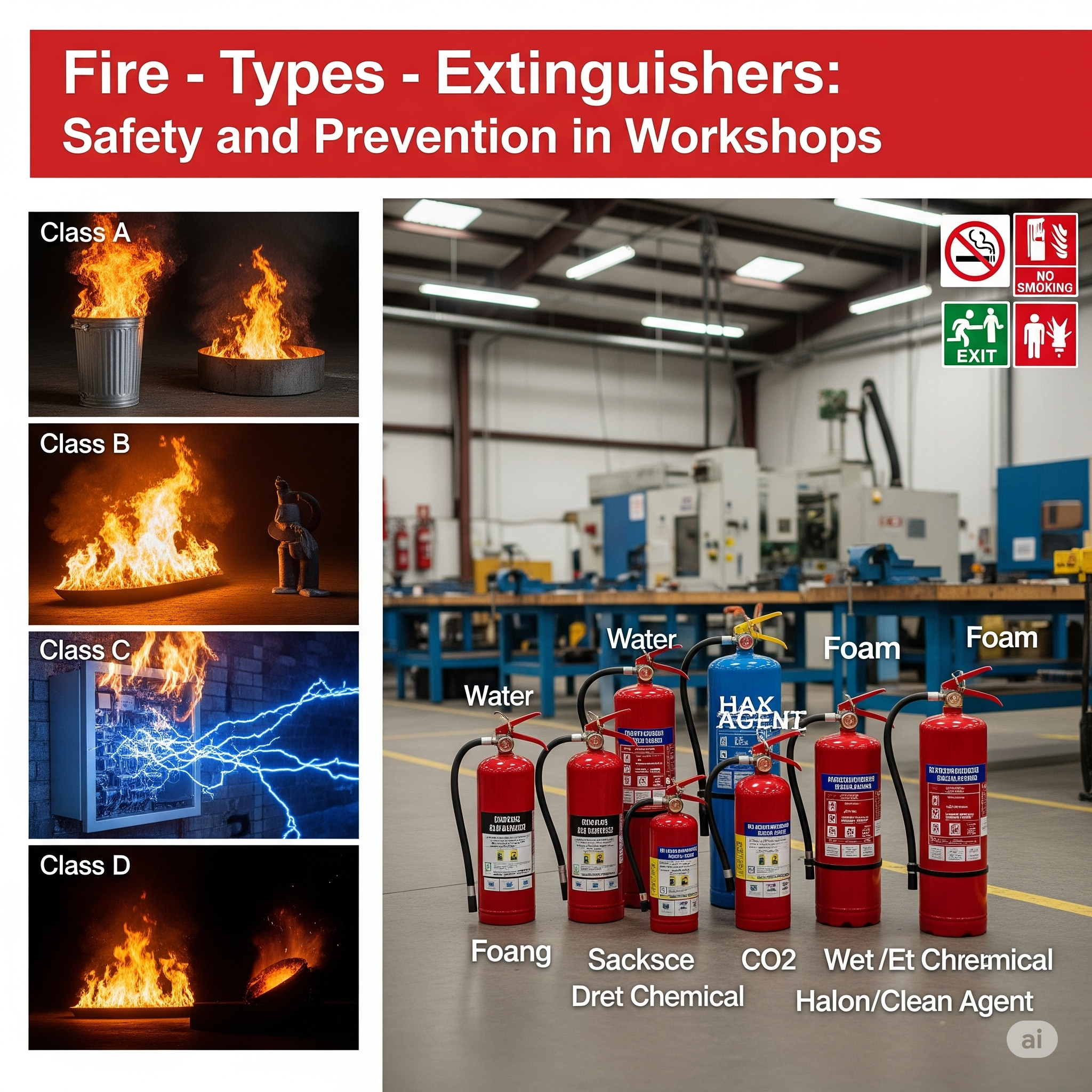
Fire – Types – Extinguishers
Learning Objectives
At the end of this lesson, you shall be able to:
- State the effects of a fire break out and causes of fire in a workshop.
- Distinguish the different types of fire extinguishers.
- State the classification of fires and basic methods for extinguishing fire.
- Determine the correct type of fire extinguisher based on the class of fire.
- Describe the general procedure to be adopted in the event of fire.
- State the method of operation of a fire extinguisher and techniques for extinguishing fire.
What is Fire?
Fire is the burning of combustible material. When fire occurs in an unwanted place, at an inappropriate time, or in an uncontrollable quantity, it can damage or destroy property, injure people, and sometimes cause loss of life. Therefore, preventing fire and knowing how to control and extinguish it is essential in any workshop or industrial environment.
Causes and Prevention of Fire

Fires can often be prevented by removing one of the three essential elements for fire to burn: fuel, heat, and oxygen. This is known as the fire triangle. Removing any one of these elements will extinguish the fire.
Common causes of fire include:
- Accumulation of combustible waste such as oil-soaked cotton, scrap wood, or paper.
- Electrical equipment faults due to misuse or neglect, such as loose connections, wrongly rated fuses, or overloaded circuits.
- Damage to insulation in cables.
- Flammable clothing or materials placed near heaters.
- Improper storage of highly flammable liquids like thinners, kerosene, adhesives, and LPG.
- Unattended blowlamps or torches.
Prevention Tips:
- Remove combustible refuse promptly.
- Ensure proper electrical maintenance.
- Keep flammable materials in designated storage areas.
- Turn off heaters and electrical equipment when not in use.
Classification of Fires
Fires are classified based on the type of fuel involved:
| Class | Type of Fire | Fuel Source | Recommended Extinguishing Method |
|---|---|---|---|
| A | Ordinary combustibles | Wood, paper, cloth, solid material | Water or foam |
| B | Flammable liquids | Gasoline, oil, grease, liquefiable gases | Foam, dry powder, CO2 |
| C | Gas fires | Gas and liquefiable gases | Dry powder, CO2 |
| D | Metal fires | Combustible metals | Special dry powders |
| Electrical | Fires in electrical equipment | Electrical circuits, devices | CO2, Halon, dry powder |
Note: Water should never be used on flammable liquids or electrical fires as it can worsen the situation.
Fire Extinguishing Methods
Fire can be extinguished by isolating or removing one of the fire triangle elements:
- Starving the fire of fuel – removes the fuel source.
- Smothering – isolates the fire from oxygen using foam, sand, or blankets.
- Cooling – lowers the temperature using water or other cooling agents.
Special precautions:
- Extreme caution is required for fires involving liquefied gases; always shut off the gas supply.
- Electrical fires require non-conductive extinguishing agents.
Types of Fire Extinguishers

Different types of fire extinguishers are designed for specific classes of fire.
- Water-filled Extinguishers
- Types: Gas cartridge or stored pressure.
- Operation can be interrupted to conserve contents.
- Suitable for Class A fires only.
- Foam Extinguishers
- Stored pressure or gas cartridge types.
- Best for flammable liquids and running liquid fires.
- Must not be used on electrical fires.
- Dry Powder Extinguishers
- Gas cartridge or stored pressure type.
- Effective for Class B, C, and D fires, including metal fires.
- Fork-shaped nozzle is a distinguishing feature.
- Carbon Dioxide (CO2) Extinguishers
- Recognizable by their horn-shaped discharge.
- Ideal for Class B fires where contamination must be avoided.
- Less effective in open-air fires.
- Halon Extinguishers
- Filled with carbon-tetrachloride or BCF (Bromochlorodifluoromethane).
- Used for electrical and delicate equipment.
Operating a Fire Extinguisher
Always follow the P.A.S.S. method for operating a fire extinguisher:
- P – Pull the safety pin.
- A – Aim the nozzle at the base of the fire.
- S – Squeeze the handle to discharge the agent.
- S – Sweep side to side over the fuel surface until the fire is completely extinguished.

Safety Measures:
- Alert nearby people by shouting “Fire! Fire!”
- Inform the fire service immediately.
- Turn off power supply and gas.
- Use emergency exits to evacuate others safely.
- Only attempt to control a fire if it is safe. If smoke is toxic, evacuate and leave it to professionals.
General Procedure in Case of Fire
- Raise an alarm.
- Turn off all machinery and electrical equipment.
- Close doors and windows (do not lock them) to limit oxygen supply.
- Identify the type of fire and choose the correct extinguisher.
- Attempt to extinguish the fire only if safe.
- Evacuate non-involved personnel to a safe assembly point.
Conclusion
Understanding fire types, extinguishing methods, and proper use of fire extinguishers is crucial for workshop safety. Proper training and preparedness can prevent accidents, minimize damage, and save lives. Remember, safety is always the top priority.
