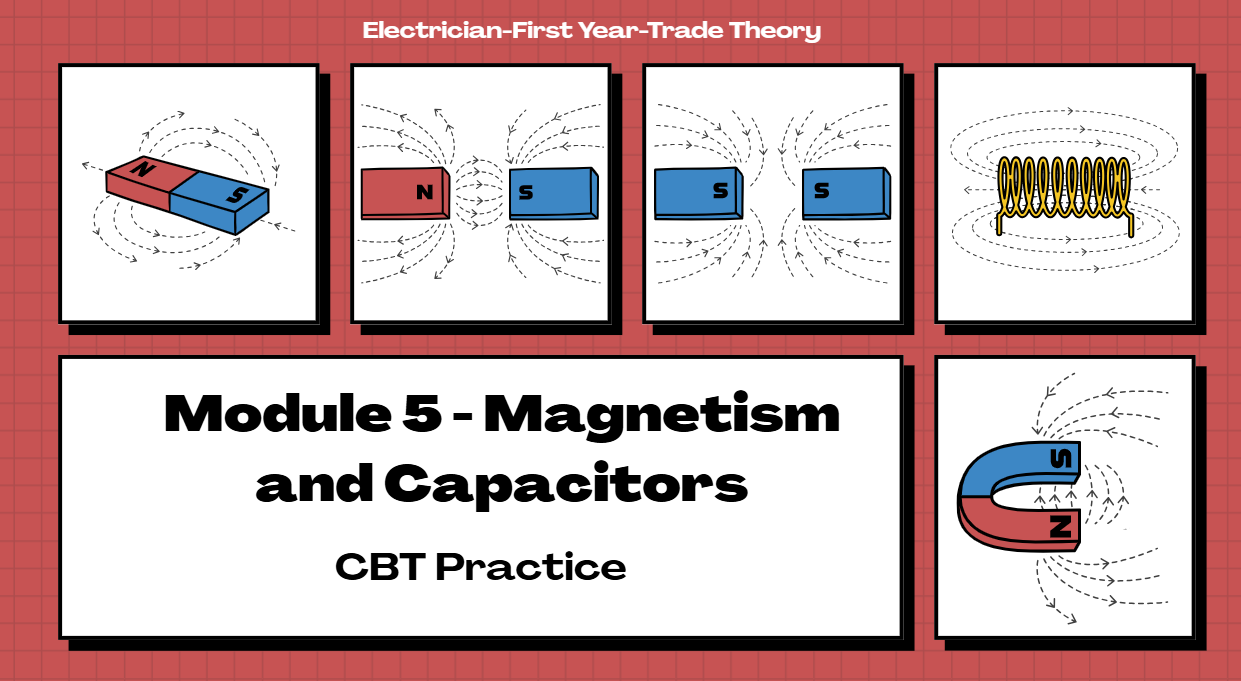
Module 5 – Magnetism and Capacitors
Welcome to Module 5 of the ITI Electrician Trade Theory syllabus. This unit covers the fundamentals of Magnetism and Capacitors, essential for understanding electromagnetic principles and AC/DC circuits.
🔍 What You Will Learn
- Basic properties of magnets
- Magnetic lines of force and flux
- Electromagnetism and its applications
- Faraday’s Laws of Electromagnetic Induction
- Self and mutual induction
- Capacitors and their construction
- Charging and discharging of capacitors
- Uses of capacitors in electrical circuits
🧲 Magnetism – Basics and Types
🔸 Natural vs Artificial Magnets
- Natural Magnets: Occur in nature (e.g., magnetite)
- Artificial Magnets: Man-made, used in electrical devices
🔸 Properties of Magnets
- Attracts magnetic materials (iron, steel)
- Always have north and south poles
- Like poles repel, unlike poles attract
🔸 Magnetic Lines of Force
- Imaginary lines around a magnet showing magnetic field direction
- Always form closed loops
- Denser lines = stronger field
Unit of magnetic flux: Weber (Wb)
Unit of magnetic field strength: Tesla (T)
⚡ Electromagnetism
🔸 What is Electromagnetism?
When electric current flows through a conductor, it produces a magnetic field around it. This is the basis of electromagnetism.
🔸 Right-Hand Rule
Used to determine the direction of magnetic field in a current-carrying conductor.
🔸 Applications of Electromagnetism
- Electric bells
- Relays
- Solenoids
- Motors and generators
🔁 Electromagnetic Induction
🔸 Faraday’s Laws
- First Law: When magnetic flux linked with a coil changes, an EMF is induced.
- Second Law: The magnitude of EMF is directly proportional to the rate of change of flux.
🔸 Lenz’s Law
The direction of induced EMF is such that it opposes the cause producing it.
🔄 Self and Mutual Induction
- Self Induction: Induction in the same coil (e.g., choke coil)
- Mutual Induction: Induction between two coils (e.g., transformer)
💡 Capacitors – Definition and Function
🔸 What is a Capacitor?
A capacitor is a passive electronic component that stores energy in the form of an electrostatic field.
Unit of capacitance: Farad (F)
🔸 Construction of a Capacitor
- Two conductive plates
- Separated by a dielectric (insulating material)
- Connected to a voltage source
🔸 Types of Capacitors
- Electrolytic Capacitor
- Ceramic Capacitor
- Paper Capacitor
- Polyester Capacitor
Each type has specific use in circuits depending on voltage rating and capacitance value.
🔋 Charging and Discharging of Capacitors
- Charging: Electrons accumulate on plates, creating a potential difference.
- Discharging: Stored energy is released into the circuit.
Applications:
- Fan regulators
- Timer circuits
- Power supplies
- Motor starting capacitors
📊 Summary of Key Terms
| Concept | Unit | Instrument |
|---|---|---|
| Magnetic Flux | Weber (Wb) | Fluxmeter |
| Magnetic Field | Tesla (T) | Gaussmeter |
| Capacitance | Farad (F) | Capacitance Meter |
